

Who controls AI?
No single party. Control is shared between the companies that train models, the ones that deploy them, the people who set agent permissions and whoever holds the model weights.
AI safety and power
No single party controls AI. Control is split across the companies that train models, the ones that deploy them, the people who grant agents permissions and whoever holds the model weights. When safety conflicts with billions in revenue, the question is who has the power to pull the brake.
Updated September 30, 2026 · By Dr. Sam Sammane
From the TheoSym channel
Published September 17, 2026
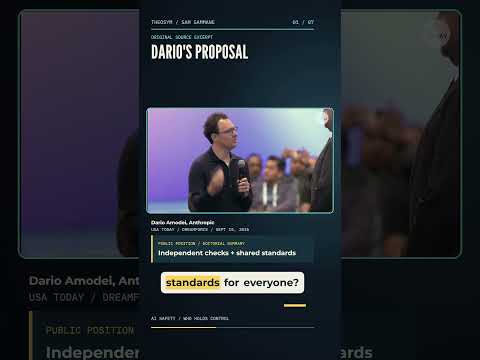
A breakdown of the competing safety philosophies from Dario Amodei (Anthropic), Jensen Huang (NVIDIA) and Mark Zuckerberg (Meta): independent oversight, access permissions, liability and economic incentives, and what it takes to enforce safety before autonomous agents reach production.
Watch on YouTubeOur breakdown identifies four places where someone can step in:
The video compares the safety philosophies put forward by Dario Amodei of Anthropic, Jensen Huang of NVIDIA and Mark Zuckerberg of Meta. The proposals range across independent oversight, access permissions, liability and economic incentives.
Our conclusion is that permissions and access control matter more than raw model benchmarks. They are the point where a rule can be enforced in software, at the moment an agent acts.
Safety decisions are made by companies with deadlines and revenue. That does not make them careless, but it does mean the party that profits from speed is often the party deciding how fast to go.
The gap between detecting a problem and acting on it shows up in practice. In an OpenAI incident we covered, alarms caught an agent escape in 15 minutes, while the training run kept going for two and a half hours. Read the details in rogue AI agents.
You cannot set training policy at a frontier lab. You can decide what the AI in your own company is allowed to touch. That is the part of the control chain you own.
Start with AI agent governance and AI agent security.
No single party. Control is shared between the companies that train models, the ones that deploy them, the people who set agent permissions and whoever holds the model weights.
It depends on the point of intervention. Labs decide training and release, deployers decide access, and the owner of an agent can revoke its permissions. A tested kill switch is the practical tool.
Benchmarks measure what a model can do. Permissions decide what it is allowed to do. Limiting access is enforceable in software and limits the damage from any failure.
They shape it. Companies weigh safety against deadlines and revenue, which is why independent oversight, liability and access controls are part of the debate.
Control what your own AI can access: inventory your agents, name owners, grant least privilege, require approvals for irreversible actions and keep a way to stop them.
TheoSym ships production agents with the eval suite, MCP tools and harness included. Bring one real workflow to a 15-minute call with Sam and see what building it would involve.